A good camera can make a cheap room look warmer, cleaner, and more alive. Bad sound ruins that work in five seconds. That is why the Sennheiser MKE 400 Shotgun Microphone dropping to a lower bundle price matters for U.S. creators who record reviews, interviews, travel clips, short films, or local business videos without a full audio crew. The draw is not only the discount. It is the fact that the kit solves several beginner problems at once: cleaner voice pickup, wind control, phone support, camera support, and a small tripod setup.
For shoppers tracking consumer tech deal coverage, this is the kind of offer that deserves a closer look before it disappears into the usual “deal of the day” noise. A mic bundle is different from a single gadget purchase because missing accessories can turn a bargain into another checkout cart later. The Sennheiser MKE 400 bundle gives buyers a more complete starting point, which is why the record-low angle feels useful instead of flashy.
Why the Bundle Price Matters More Than the Sticker
A lower price gets attention, but the real value sits in what the box keeps you from buying later. Many creators start with a camera or phone, then learn the hard way that clean audio needs more than a mic clipped on top. You need the right cable. You need wind help. You need a way to place the phone steady. You need enough control to stop loud rooms from flattening your voice.
That is the quiet win here. The Sennheiser MKE 400 bundle is not aimed at studio owners with drawers full of gear. It is built for the person filming a product demo at a kitchen table, a realtor recording a walkthrough in Phoenix, or a YouTuber shooting a car review near a busy road in Ohio. The tension is simple: viewers forgive a plain background faster than they forgive harsh, thin, or distant audio.
What makes a bundle deal smarter for new creators?
A single mic price can look lower until the small items start piling up. Add a phone clamp, mini tripod, outdoor wind cover, and cables, then the “cheap” route often stops being cheap. That is why a creator audio kit can make sense even for people who hate buying kits. The right one removes guesswork.
This bundle also reduces the risk of buying the wrong connector. Many camera users need TRS. Many phone users need TRRS or an adapter path. Sennheiser lists interchangeable 3.5 mm TRS and TRRS connectivity, along with wind protection, internal shock mounting, low-cut filtering, and a headphone output with volume control on its product page.
The non-obvious part is that accessories can protect your time more than your wallet. If you plan to film a Facebook Marketplace car listing at 6 p.m., you do not want to discover your phone clamp is missing or your cable is wrong. A bundle that prevents that small failure has value beyond the sale tag.
Why “record low” can still be a trap without context
A low bundle price is only worth chasing when the gear fits the way you shoot. If you record seated podcast clips in a treated room, a desk mic may still serve you better. If you record weddings from across a ballroom, this is not a magic fix. Directional camera mics help most when the subject is close enough and the mic points where the voice is coming from.
That matters because deal pages often make every discount feel urgent. A smarter buyer asks two questions: “Will this improve my next five videos?” and “Does it replace things I already planned to buy?” If both answers are yes, the offer becomes easier to judge.
For a small U.S. creator, the best example is a local food reviewer. In a crowded taco shop in San Diego, built-in phone audio catches chatter, chairs, and music. A directional mic on a compact rig will not erase the room, but it can put the speaker’s voice in front. That small shift can make the clip feel more watchable.
How a Shotgun Microphone Changes Everyday Video
The biggest audio mistake new creators make is thinking the camera hears like a person. It does not. Your ears filter a room without asking you. A camera or phone mic grabs whatever reaches it, often with no concern for what matters. That is why voices can sound far away even when the face fills the frame.
A camera-mounted directional mic gives the recording a stronger sense of aim. It listens harder in the direction it points, which helps your voice stand apart from the room. It does not create silence around you. That expectation leads to disappointment. The better promise is more believable: it helps the main sound feel closer, cleaner, and less lost.
Cleaner voice pickup without building a studio
Most creators do not have a treated room. They have a spare bedroom, garage, porch, car, or rented apartment where the fridge hums and the air conditioner kicks on mid-sentence. The MKE 400’s low-cut filter is useful in those imperfect spaces because low rumble often makes a recording feel heavier than it should. You may not notice the rumble while filming. You notice it during editing.
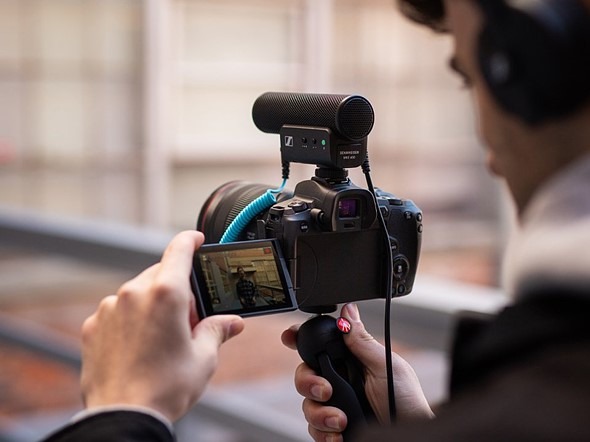
This is where an on-camera microphone earns its place. You can mount it, set the gain, check levels through headphones, and record without turning the room into a lab. It gives you enough control to avoid the worst mistakes, which is what most creators need at first.
There is a counterintuitive lesson here: better audio gear often teaches restraint. You stop raising the voice. You move closer. You check the wind. You frame the shot around the sound, not only the image. The mic becomes a reminder to film with more care.
Why small size matters more than specs for run-and-gun filming
Spec sheets help, but the best camera gear is the gear you do not leave home. Sennheiser lists the MKE 400 at 126 x 67 x 37 mm and notes the Mobile Kit option includes the microphone, smartphone clamp, and Manfrotto PIXI Mini Tripod. That size matters when you are packing a sling bag instead of a full case.
A larger setup can sound better in the right hands. It can also slow you down. If you are filming a quick interview at a high school football field, a farmer’s market, or a trade booth in Las Vegas, the person in front of the camera may only give you two minutes. Small gear keeps the moment from slipping away.
That is why the creator audio kit angle feels practical. It is not about pretending a tiny rig beats a boom operator. It is about getting cleaner sound when the shoot is moving, the light is fading, and nobody has patience for a complicated setup.
Who Should Buy It, and Who Should Skip It
A good deal still needs a good match. The MKE 400 line sits in a useful middle space: more serious than built-in audio, less demanding than a full wireless or boom setup. That makes it attractive for creators who want better results without learning an entire sound department’s workflow.
The best buyer is someone who films close-range talking content. Think real estate tours, street interviews, YouTube explainers, gear reviews, campus videos, and short business promos. If your subject is usually within a few feet, the mic has a fair chance to help. If your subject is across the room, physics wins.
Best use cases for creators, students, and small brands
For a college media student, this kit can work as a clean starter setup for class projects and campus interviews. For a small gym owner, it can help record trainer tips without the voice getting buried under machines. For a travel creator, it can keep a walking narration from sounding like it was recorded inside a pocket.
The Sennheiser MKE 400 bundle also fits people who switch between phone and camera work. That matters because many creators do not use one device forever. They film Instagram clips on a phone, then record longer YouTube videos on a mirrorless camera. A kit that can follow both habits has a longer shelf life.
One practical example: a local realtor in Dallas can shoot a vertical home-tour reel on a phone in the morning, then use a camera for a longer neighborhood video in the afternoon. The same audio setup can support both shoots with less packing drama.
When a lav mic or wireless system makes more sense
This is not the best answer for every voice problem. If you record a speaker who turns away from the camera, a lav mic clipped near the chest may work better. If two people talk while walking side by side, a dual wireless kit may be cleaner. If you record seated interviews in a fixed space, a boom placed closer to the speaker can beat an on-camera setup.
That does not make this deal weak. It means the tool has a lane. A camera-mounted mic is strong when you need speed, simplicity, and direction. It is weaker when the sound source moves away or sits off-axis.
The non-obvious buying advice is this: do not buy the most “pro” option if it makes you film less. A simple on-camera microphone that gets used three times a week can improve your channel faster than a better system that stays in a drawer because setup feels annoying.
How to Judge This Deal Before You Checkout
A record-low bundle price can move fast, so the mistake is either panic-buying or overthinking until the offer is gone. The better path is a short checklist. Confirm the seller, confirm the kit contents, confirm return terms, and confirm the gear matches your phone or camera workflow.
This is also where good comparison shopping helps. Look at the mic-only price beside the bundle price. Then price the accessories you would buy anyway. If the gap is small, the bundle has a stronger case. If you already own a tripod, clamp, wind cover, and cables, the deal may lose some shine.
Check kit contents, warranty, and seller trust
Start with the box. The Mobile Kit is commonly described with the mic, smartphone clamp, Manfrotto PIXI mini tripod, cables, and outdoor wind protection, and B&H lists its kit with those key recording pieces plus batteries and warranty details on its product page. That is the kind of detail you want before buying.
Authorized sellers matter because audio gear gets moved through open-box, import, and gray-market channels. A few dollars saved can become less appealing if warranty support turns messy. U.S. shoppers should also check shipping time, return window, and whether the price is for the current generation.
Use camera gear buying tips when comparing accessories across brands, then keep a second note for creator setup ideas so you do not buy the same part twice under different names.
Compare the bundle against your real filming habits
Your next five shoots tell you more than a spec chart. Are you filming outside? Wind protection matters. Are you using a phone for vertical reels? The clamp and tripod matter. Are you filming on a mirrorless camera? Cable support and cold-shoe mounting matter. Are you recording in loud public spaces? Distance matters most.
The official MKE 400 product page describes features such as a supercardioid pickup pattern, internal suspension, wind protection, low-cut filter, 3-step sensitivity switch, and headphone monitoring, which are all aimed at giving creators more control at the point of recording.
The surprising part is that a discount can make you more honest. At full price, you may talk yourself into waiting for a bigger setup. At a lower bundle price, the question changes: “Would this make my next upload sound better this week?” If yes, that is a cleaner buying reason than chasing the fanciest rig.
Conclusion
The best creator purchases are not always the ones with the loudest specs. They are the ones that remove the problem you keep editing around at midnight. Weak voice audio is one of those problems. It makes good footage feel amateur, and it makes viewers leave before the message lands.
A discounted creator audio kit earns attention because it helps solve that problem without asking you to rebuild your whole setup. The Sennheiser MKE 400 Shotgun Microphone fits creators who need cleaner close-range voice capture, easier phone-and-camera use, and enough control to handle common filming spaces. It will not replace smart placement, quiet rooms, or good recording habits. No mic does.
Still, this bundle makes sense for U.S. vloggers, students, small brands, and solo shooters who want an upgrade they can carry, mount, and understand fast. Check the seller, confirm the kit, compare the mic-only price, and buy only if it fits the way you film. Better sound is not a luxury once people are listening.
Frequently Asked Questions
How much should I pay for the Sennheiser MKE 400 bundle?
A fair price depends on the seller, kit contents, and whether it is new, open-box, or refurbished. Compare the bundle against the mic-only version plus a phone clamp, mini tripod, wind cover, and cables. The deal is stronger when those extras cost more separately.
Is the MKE 400 good for YouTube videos?
Yes, it works well for close-range talking videos, product reviews, travel clips, and quick interviews. It is best when the speaker stays near the camera and faces the mic. For distant subjects or two-person conversations, a lav or wireless system may work better.
Can I use the MKE 400 with an iPhone?
Yes, but your exact setup may need the right adapter, especially on newer iPhones without a headphone jack. The kit includes phone-friendly connection support, yet buyers should confirm their iPhone model, adapter type, and recording app before filming important work.
Is an on-camera microphone better than built-in camera audio?
In most close-range filming, yes. Built-in camera mics often pick up room noise, handling sounds, and distance in an unflattering way. A directional camera mic gives your voice more focus and control, especially when paired with better placement and wind protection.
Does the MKE 400 work outdoors?
Yes, it is designed with built-in wind protection, and the kit commonly includes a furry windshield for stronger outdoor help. Wind can still overpower any small mic, so placement matters. Block side gusts when possible and monitor through headphones before recording.
Who should skip this bundle?
Skip it if you mostly record speakers far from the camera, need two-person wireless audio, or already own similar accessories. It may also be unnecessary for desk-only podcasting, where a fixed USB or XLR mic can sit closer to your mouth.
What is the best alternative to this type of camera mic?
A lavalier mic is often better for one seated speaker or a subject who turns away from the lens. A wireless kit is better for walking interviews. A camera-mounted directional mic is better when you need a fast, simple rig for solo filming.
Why does audio matter so much for creator videos?
Viewers can tolerate average lighting longer than harsh or distant sound. Clear voice audio makes the content easier to trust, follow, and finish. Better audio also reduces editing stress because you spend less time trying to repair problems that started during recording.